I recently stumbled upon a series of YouTube book summaries by Clark Kegley. Clark does a great job of distilling (self-help) books down to a few useful tips that you can apply to your everyday life. Although not a substitute for actually reading, these book summary videos can be a useful tool to help recall important tips from the book. Here are my top 5 tips from Tim Ferriss's 'The 4-Hour Workweek':
1) The 3 currencies of life: time, energy and money
When you're young you have a lot of time and energy, but usually you lack money. When you're an adult usually you have energy and money, but you don't have time because you're working. Finally, when you reach old age, you have time and money, but you no longer have energy.
The important point here is not to value life by a single currency (money), but instead see that life is made up of multiple currencies. With this concept you can try to manage, leverage, and exchange these currencies throughout different stages of your life.
2) Four W's of Freedom: who, what, where, when
Money is no longer the yard stick that defines being rich, instead it's freedom. What does freedom mean? Freedom can be defined as having control over the four W's:
Who - choosing to work with people you like and respect
What - choosing to do the work that interests you
Where - choosing to work from your desired location
When - working at the time you choose
The more W's you control the more free you are. In most cases having more money could give you control of more W's. However, depending on your work, more money may not help. Regardless, it's important to recognize that these factors influence your freedom and that you may be able to come up with creative ways to control more W's in your life (e.g. be a freelance copywriter).
3) DEAL: define, eliminate, automate, liberate
This is an acronym used to help you remember four important tools that could help you reach your freedom goals:
Define - be absolutely clear about what you want
Eliminate - stop wasting time on unimportant things (e.g. block Facebook)
Automate - remove yourself from the workflow (e.g. outsource tasks)
Liberate - free your working location (e.g. telecommute)
4) Having all the time is not the goal
All this discussion about freedom could be miscontrued as a message to stop working. Life without work can become boring, meaningless, and empty. Therefore, it is important to have meaningful work because it provides a venue for both giving to society, as well as personal growth.
The goal is to have an adequate balance of work, rest, and play. Work can be an enjoyable part of life if you're doing the right kinds.
5) 80/20 Principle and Parkinson's Law
Also known as the Pareto Principle, the 80/20 principle states that roughly 80% of the results come from 20% of the causes. This principle is commonly cited in business where it is commonly observed that 80% of sales come from 20% of the customers. The priority would be to keep those customers happy.
A 'vital few' of our actions leads to the majority of our results. We must first identify what those few things are, then focus our efforts there.
Parkinson's law states that "work expands to fill the time available for its completion". To harness this law you could shorten deadlines.
Here is Clark's video book summary:
Interesting tips to help make your money go further. Updates are frequent so be sure to check out the site often!
Showing posts with label Book Review. Show all posts
Sunday, July 16, 2017
Sunday, May 7, 2017
Think and Grow Rich - Napolean Hill
Think and Grow Rich by Napolean Hill is a must read personal finance book. This book is not a practical guide with current tips on how to start an "e-business", but rather a study on the philosophy of the most successful people in recent history.
Hill first published this book in 1937, at the height of the great depression. Hill ventured to write a book chronicling the mindsets of the wealthiest people of his era (e.g. Andrew Carnegie).
I found an excellent book review on this Youtube channel (Clark Kegley) and have written out the top 8 take-home messages:
- Mindset - It's more about the person you become and skills that you acquire than the dollars in your bank account.
- Think - It's important to take time to think deeply (e.g. meditate or go for a long walk). It takes time to have good ideas. Keeping a journal is a great way to achieve clarity.
- Desire - Successful people are always driven by an obsession for their craft.
- Organized Planning - Breakdown large goals into smaller ones. Achieving smaller goals will keep you motivated. Never set a goal without doing something towards its attainment.
- Persistence - Success is often just one step beyond failure, don't give up! The media loves to publicize "overnight successes" without mentioning the 10 years of hard-work.
- Seek Feedback - Constantly seek feedback for improving. Always get a 2nd opinion and listen to the wisdom/advice of people who you wish to emulate. You are the average of the 5 people you spend the most time with.
- Specialized Knowledge/Skill - Expert knowledge is impossible to outsource. Knowing a lot about a specific topic/having a specialized skill will increase your value.
- Faith - Believe in yourself. A quote that summarizes this point is to "fake it 'till you make it."
Monday, September 2, 2013
Another Book from the Shark Tank
Robert Herjavec is best known for his roles on the reality television shows Dragon's Den and Shark Tank. In these shows budding entrepreneur's approach self-made millionaires for capital to help seed the growth of their business.
Robert Herjavec's "The Will to Win" is less of an autobiography (although he does talk about his upbringing and background) and more of a book packed with business advice and career tips. Robert is the son of a Croatian migrant who immigrated to Canada as a young boy. His father was stuck at a dead end job for his entire life sweeping factory floors because it was difficult for a non-english speaking immigrant to get decent work. Despite his father's bleak job opportunities, he was happy to move to a country where people were free to express their political opinions.
Robert started from humble beginnings and from that developed a strong work ethic and drive to succeed. Robert's initial source of wealth was a security software company he started. Later as his wealth grew he invested in various other things.
This book contains a lot of tip lists such as:
- Ten ways to measure productive fun
- How salespeople can handle rejection
- Three ways good leaders handle communication
I found that the tone of this book was sometimes that of a lecturing parent and sometimes the advice was a bit lofty and abstract. Something that any football coach would yell, like "work hard", "don't cheat", etc... . I found that the most interesting bits were the actual stories he told about his work experiences and the deals he's made. If you like the show Dragon's Den and/or Shark Tank than you'd probably like this book. Also, there is a book available by Kevin O'Leary another Dragon/Shark that you'd probably like (Kevin O'Leary).
Here's a short clip about the book:
Robert Herjavec's "The Will to Win" is less of an autobiography (although he does talk about his upbringing and background) and more of a book packed with business advice and career tips. Robert is the son of a Croatian migrant who immigrated to Canada as a young boy. His father was stuck at a dead end job for his entire life sweeping factory floors because it was difficult for a non-english speaking immigrant to get decent work. Despite his father's bleak job opportunities, he was happy to move to a country where people were free to express their political opinions.
Robert started from humble beginnings and from that developed a strong work ethic and drive to succeed. Robert's initial source of wealth was a security software company he started. Later as his wealth grew he invested in various other things.
This book contains a lot of tip lists such as:
- Ten ways to measure productive fun
- How salespeople can handle rejection
- Three ways good leaders handle communication
I found that the tone of this book was sometimes that of a lecturing parent and sometimes the advice was a bit lofty and abstract. Something that any football coach would yell, like "work hard", "don't cheat", etc... . I found that the most interesting bits were the actual stories he told about his work experiences and the deals he's made. If you like the show Dragon's Den and/or Shark Tank than you'd probably like this book. Also, there is a book available by Kevin O'Leary another Dragon/Shark that you'd probably like (Kevin O'Leary).
Here's a short clip about the book:
Saturday, July 16, 2011
How to Want What You Have

In our quest to banish our debt and reach financial freedom we often get caught up with keeping up with the "Jones". We often end up making poorly thought out purchases that bring us temporary joy, that lacks long term fulfillment. How to Want What You Have by Timothy Miller is a great book that teaches a fundamental philosophy to live by. In it Miller describes the basic human instinct that drives us to perpetually desiring More.
We are never quite satisfied with what we have because a basic survival instinct is to strive to become the "leader of the pack". Whether we do this by obtaining status symbols or accumulating wealth there is a deep desire to continually consume. The problem is that once we reach the bar we set, it ends up just rising again. Miller explains where this instinct originates and some ingenious methods in overcoming this instinct.
The three principles in which he presents in the book are Compassion, Attention, and Gratitude.
Compassion: is the ability to understand that all others around us are pretty much striving for the same things in different ways. Also we must understand that no one is more entitled to getting what they want more than you are. When we have compassion for the people around us we become less critical and judgmental which frees us from hate filled feelings towards others.
Attention: is focusing on the present. Sometimes we get so caught up in reaching our goals we forget to stop and smell the roses. Attention means not dwelling on the mistakes of the past and not wishing for a better tomorrow. Attention means belonging to the now and enjoying the present for all that it is.
Gratitude: is being grateful for what you have. We live in one of the most wealthy countries in the world. An individual in Canada may not think of themselves as wealthy compared to friends, neighbours or family, but in reality we are in the top 5% of the wealthiest in the world. A majority of the world's population is more worried about how they will feed there family tomorrow rather than how they will get there plasma screen and surround sound set up.
This book should be read before any other personal finance books because it helps set the foundation for a meaningful life. Having this insight will help us set meaningful goals that will bring us lasting joy and purpose. As the saying goes true happiness comes from not having what you want, but wanting what you have.
Don't take my word for it. Here is a video of the Dalai Lama's thoughts about inner peace, happiness and money:
Tuesday, August 10, 2010
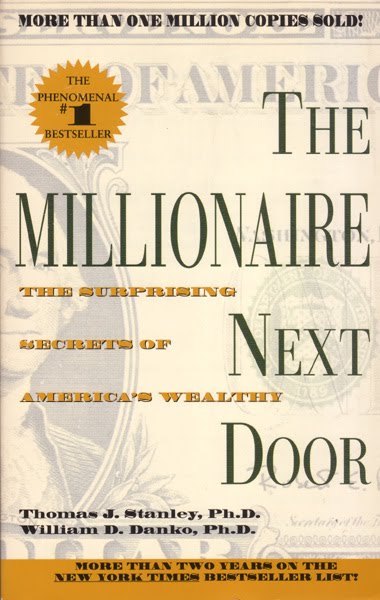
The Millionaire Next Door: Read It!

This is one of the best personal finance reads out there. I would highly recommend this read for anyone who wants to learn more about how to become wealthy and the misconceptions that we have about the wealthy. In Thomas Stanley & William Danko's "The Millionaire Next Door" they probe into the lives of 500 affluent people to discover some amazing facts and similarities the wealthy share.
We often associate the wealthy with expensive Lamborghini's, yachts, and mansions. In most cases the most affluent can be your next door neighbour who drives a Toyota. There is an old saying "all hat, no cattle." This is one of the main messages of the book. People who usually give the appearance of ultra wealth are often just fakes. Their expensive tastes and habits are financed by loans and credit cards, so these type of people are usually deep into debt. People who end up building wealth are the ones who are smart consumers and well educated in the realm of personal finance. They are often business owners and have started with next to nothing.
One of the questions this book addresses is why some people who have won the lottery become bankrupt in a short amount of time afterwards. You would think that someone who won the lottery would never have to work again, but history has shown that most lottery winners end up in the same place they were before they won the lottery. Someone who was not used to having such money stumbles upon a fortune instantly. Their spending habits haven't changed nor has there financial literacy/IQ. In that case the money is lost as quickly as it was granted. This emphasizes the importance of how the wealth was generated and the development of your own financial knowledge.
The thing about people who have built their wealth from scratch is that they have very high financial IQ's. They have learned how money works and are able to use that knowledge to the fullest. There are cases of wealthy people with high financial IQ's that were close to losing everything, but were able to rebuild their wealth quickly because of their financial knowledge. Donald Trump is a great example of someone who has an exceptionally high financial IQ. There was once a time when he was millions of dollars in debt but rebounded to becoming one of the wealthiest men in America because of his financial knowledge. This book tells the story of the most affluent people in America and sheds light on the misconceptions we have about the wealthy. We can learn a lot about how this minority operates and hopefully gain some incite into our own financial lives. This book is a definite two thumbs up, borrow it from the library today!
We often associate the wealthy with expensive Lamborghini's, yachts, and mansions. In most cases the most affluent can be your next door neighbour who drives a Toyota. There is an old saying "all hat, no cattle." This is one of the main messages of the book. People who usually give the appearance of ultra wealth are often just fakes. Their expensive tastes and habits are financed by loans and credit cards, so these type of people are usually deep into debt. People who end up building wealth are the ones who are smart consumers and well educated in the realm of personal finance. They are often business owners and have started with next to nothing.
One of the questions this book addresses is why some people who have won the lottery become bankrupt in a short amount of time afterwards. You would think that someone who won the lottery would never have to work again, but history has shown that most lottery winners end up in the same place they were before they won the lottery. Someone who was not used to having such money stumbles upon a fortune instantly. Their spending habits haven't changed nor has there financial literacy/IQ. In that case the money is lost as quickly as it was granted. This emphasizes the importance of how the wealth was generated and the development of your own financial knowledge.
The thing about people who have built their wealth from scratch is that they have very high financial IQ's. They have learned how money works and are able to use that knowledge to the fullest. There are cases of wealthy people with high financial IQ's that were close to losing everything, but were able to rebuild their wealth quickly because of their financial knowledge. Donald Trump is a great example of someone who has an exceptionally high financial IQ. There was once a time when he was millions of dollars in debt but rebounded to becoming one of the wealthiest men in America because of his financial knowledge. This book tells the story of the most affluent people in America and sheds light on the misconceptions we have about the wealthy. We can learn a lot about how this minority operates and hopefully gain some incite into our own financial lives. This book is a definite two thumbs up, borrow it from the library today!
Sunday, July 25, 2010
The 4 Hour Workweek

This is an excellent book for the entrepreneur at heart. It's a story about a man who created the ideal business system. Timothy Ferriss explains how he created a company which he owns and spends less than 4 hours a week operating. How is that possible you say? Well it didn't happen overnight and at the beginning he did have to work hard building it up. But once he had good systems in place, the company pretty much ran itself.
Timothy started a company selling body building supplements. He advertised in the back of fitness magazines and carved out market share in a niche market. His product was quite specialized and that meant he was catering to a very specific customer base. He started a website that was able to automate the ordering process, outsourced all the frequently asked questions to a call center in India and gave a few managers authority to handle any complaints under $100. There are a couple other tips, but with those main business systems in place he was able to widdle down his work week to a meager 4 hours! This gave him time to travel, develop new businesses and train for his professional kick boxing career.
Timothy's writing style keeps the story engaging, although he may appear arrogant at some times. He presents good ideas and gives a concrete example of a supremely efficient business model. We can all learn a lot from the way he built his business and took advantage of modern technology. The book is short so give it a read. When your work week is down to 4 hours drop me a line!
Subscribe to:
Posts (Atom)